Posted by: briellethefirst | October 14, 2013

Whew!


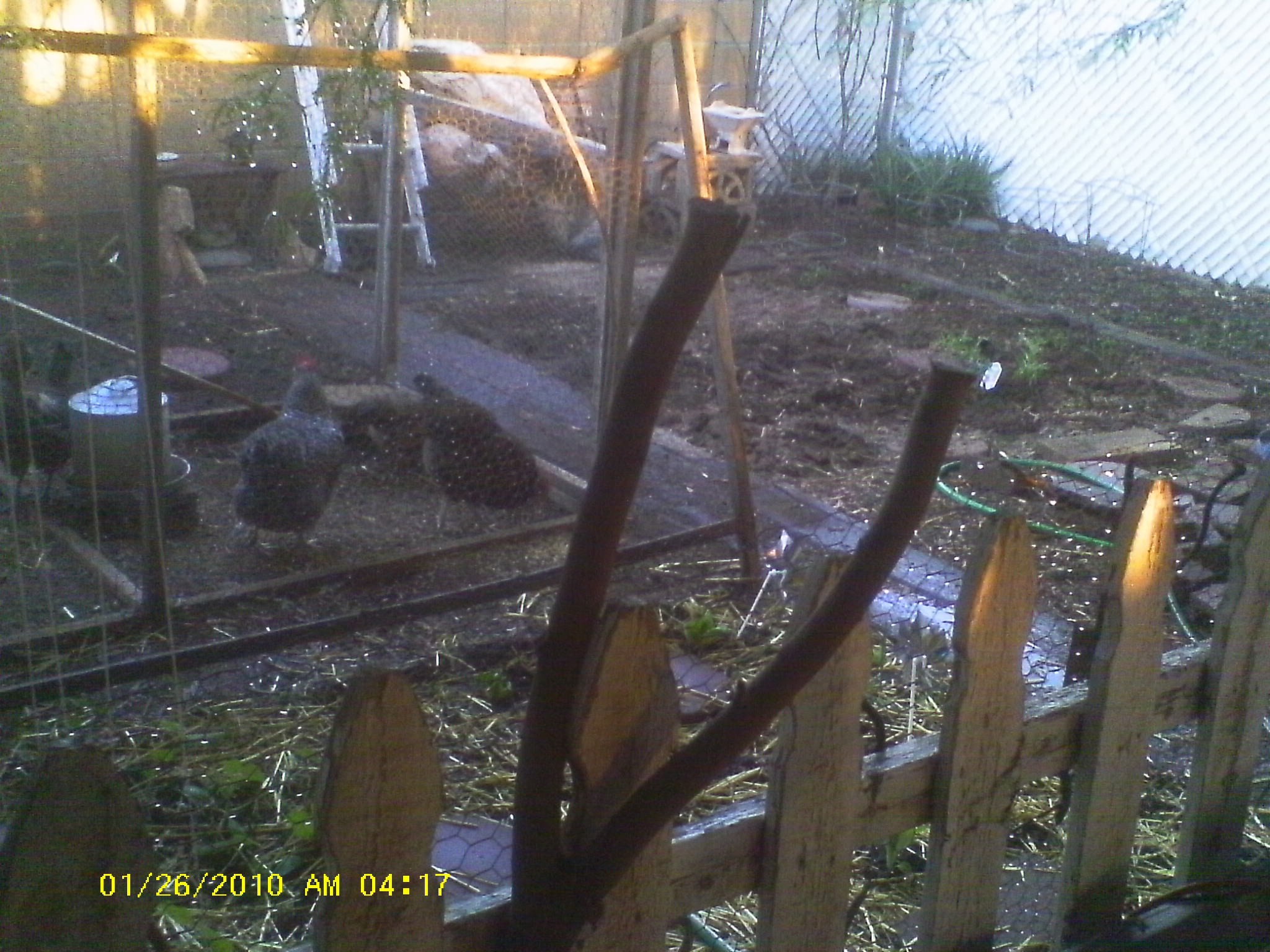
NOW (I think) the garden is puppy-proof.

Puppyproofing

Chicken wire, better rope fastening & a cement block

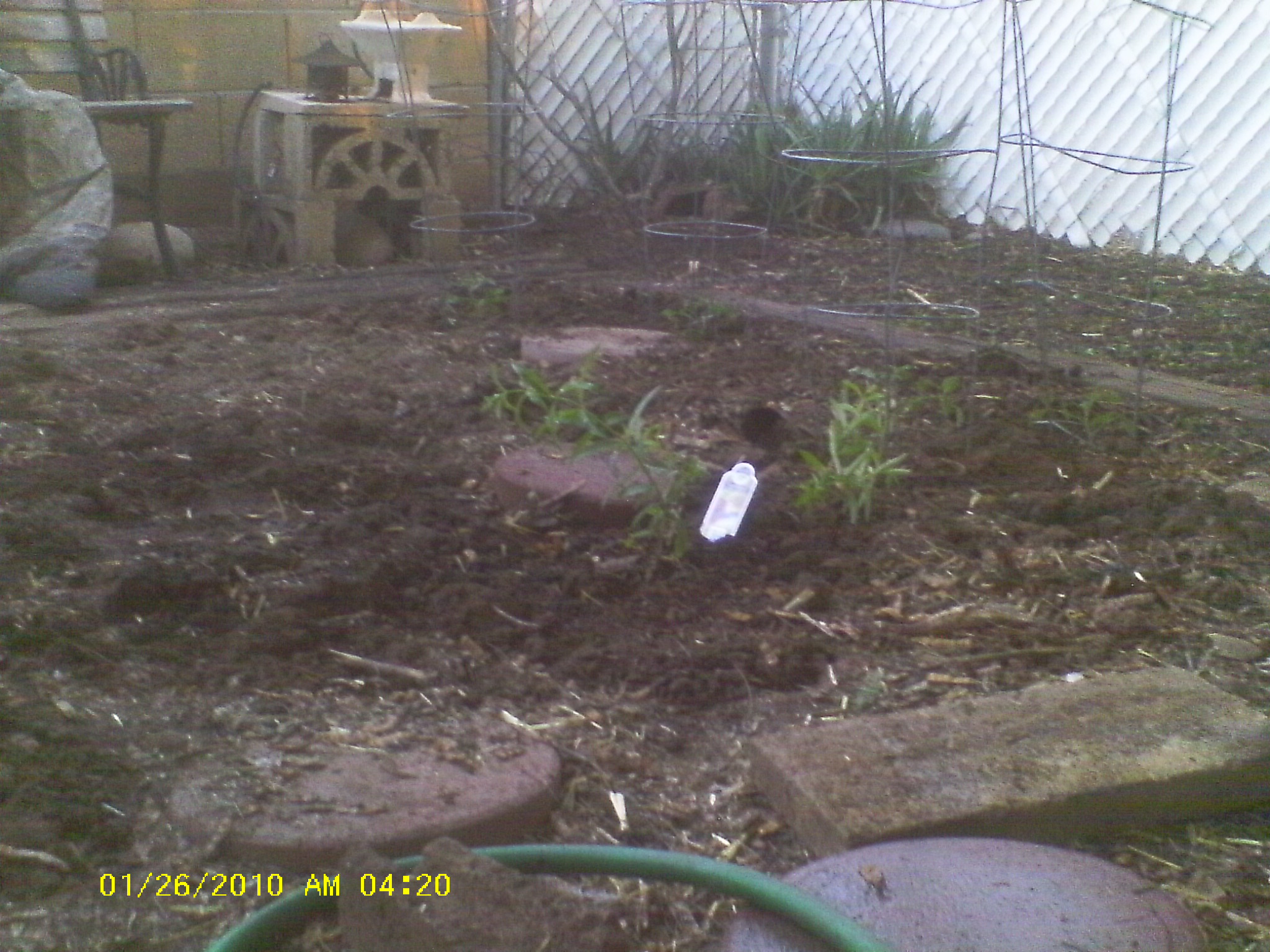
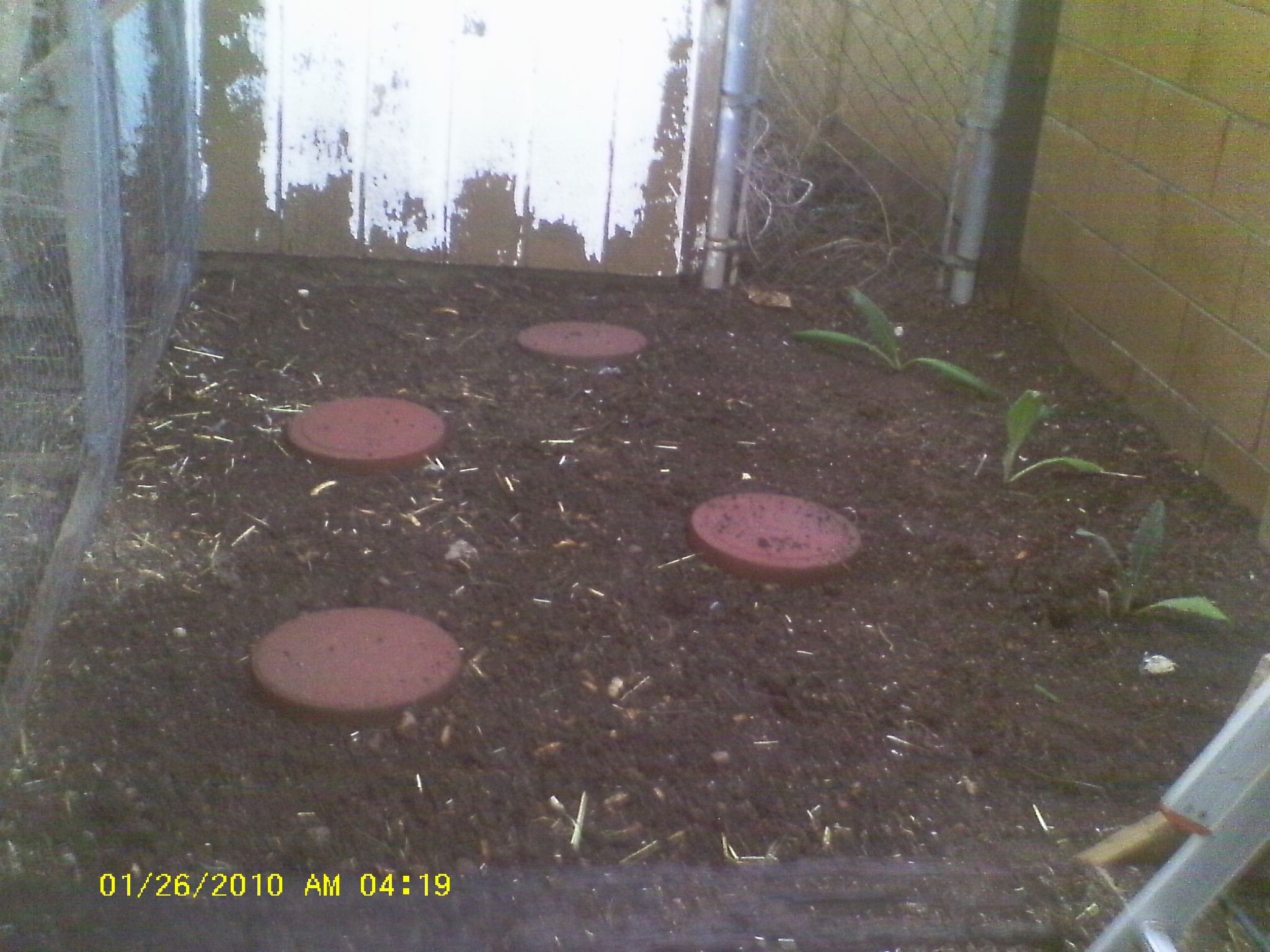
We’ll see. The special coloured cotton (green and brown), some flowers, melons and zucchini have been replanted. I put in the artichokes, Yukon gold potatoes,

Artichokes & potatoes

Artichokes, Yukon gold potatoes etc.

red potatoes and 2 purple potatoes (to surprise the kids when they help me dig the new potatoes). I also planted more alyssum, carrots and leeks around the edges of the beds and put 2 sweet 100 tomatoes in one corner and a couple of yellow pear tomatoes in another corner with lemon verbena in the middle and a ginger rhizome in another corner of what I’ve dug so far.

& a purple surprise hiding

Tomatoes, potatoes, ginger & lemon verbena.

Sprinkled a couple borage seeds in there too. Looks like the garden’s about 1/4 done. Now to pick up some strawberries and figure out what else to put in the last bit of the garden. Maybe some beans and mustard. Somehow I always run out of garden before I run out of seeds and 6-packs. If you noticed the pinwheels, those are to scare away the birds before they eat my lettuce. We’ll be getting dinner from the garden in a few weeks.

Getting there

Almost done!

still growing

The 1st bit planted showing progress.

Posted by: briellethefirst | April 6, 2013

Home-Made Fly Trap


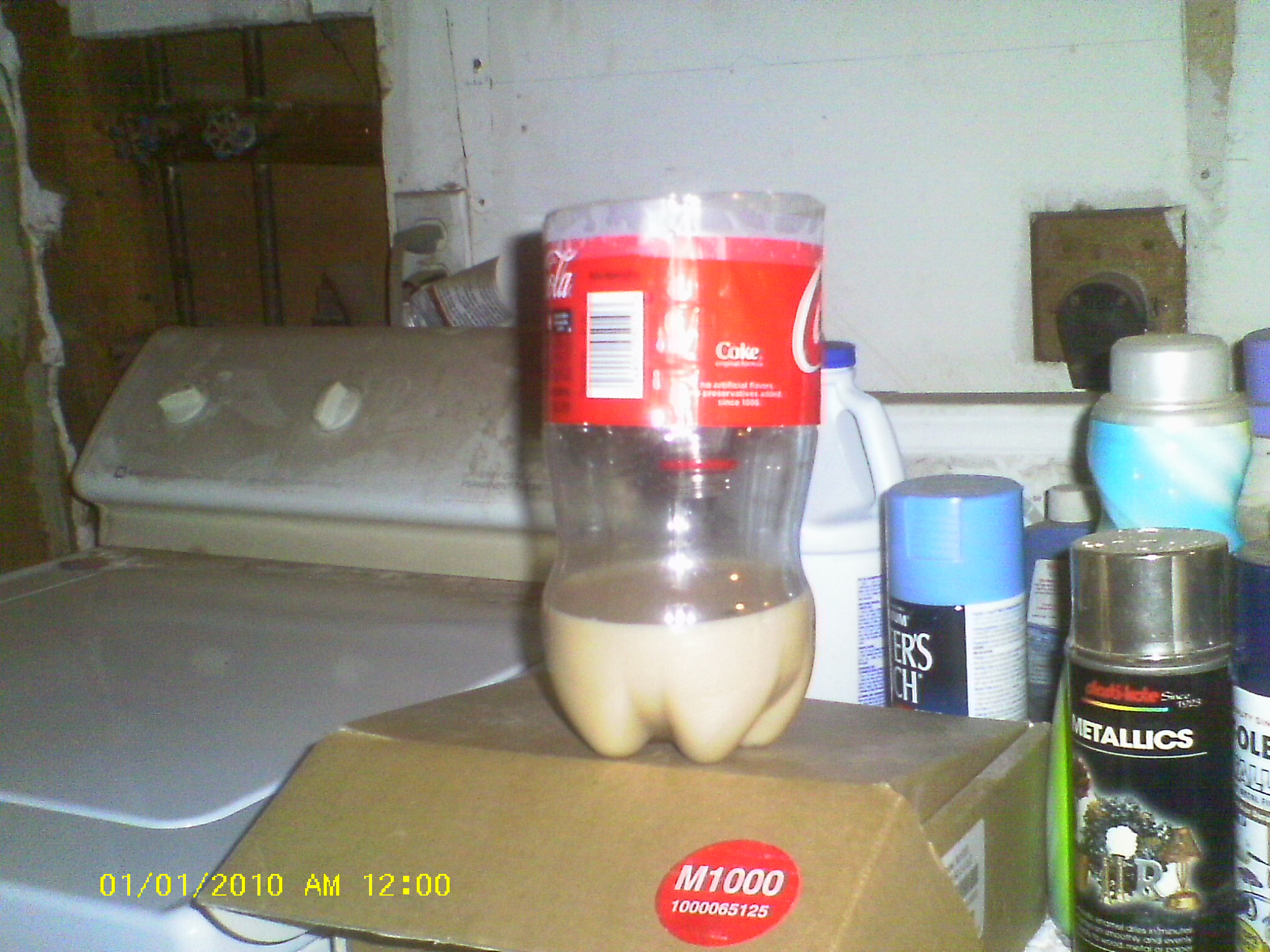
It’s getting warm around here and the kids are playing outside more. And leaving the door open…or was that just an odd burst of wind that blew it open? Of course it was. Anyway, there’s a couple of pesky flies buzzing around…what to do, what to do? Flypaper always seems to catch me just beyond my peripheral vision in nasty and icky ways. Those cheap commercial ones from the hardware store or the feed and seed work great but smell beyond terrible! Here’s something inexpensive you can do in no time at pretty much no cost. Pull a plastic soda or water bottle out of the recycling. Cut the top off and toss the cap (unless you save them for the codes on the inside).

Decapitate a soda bottle

Decapitate a soda bottle

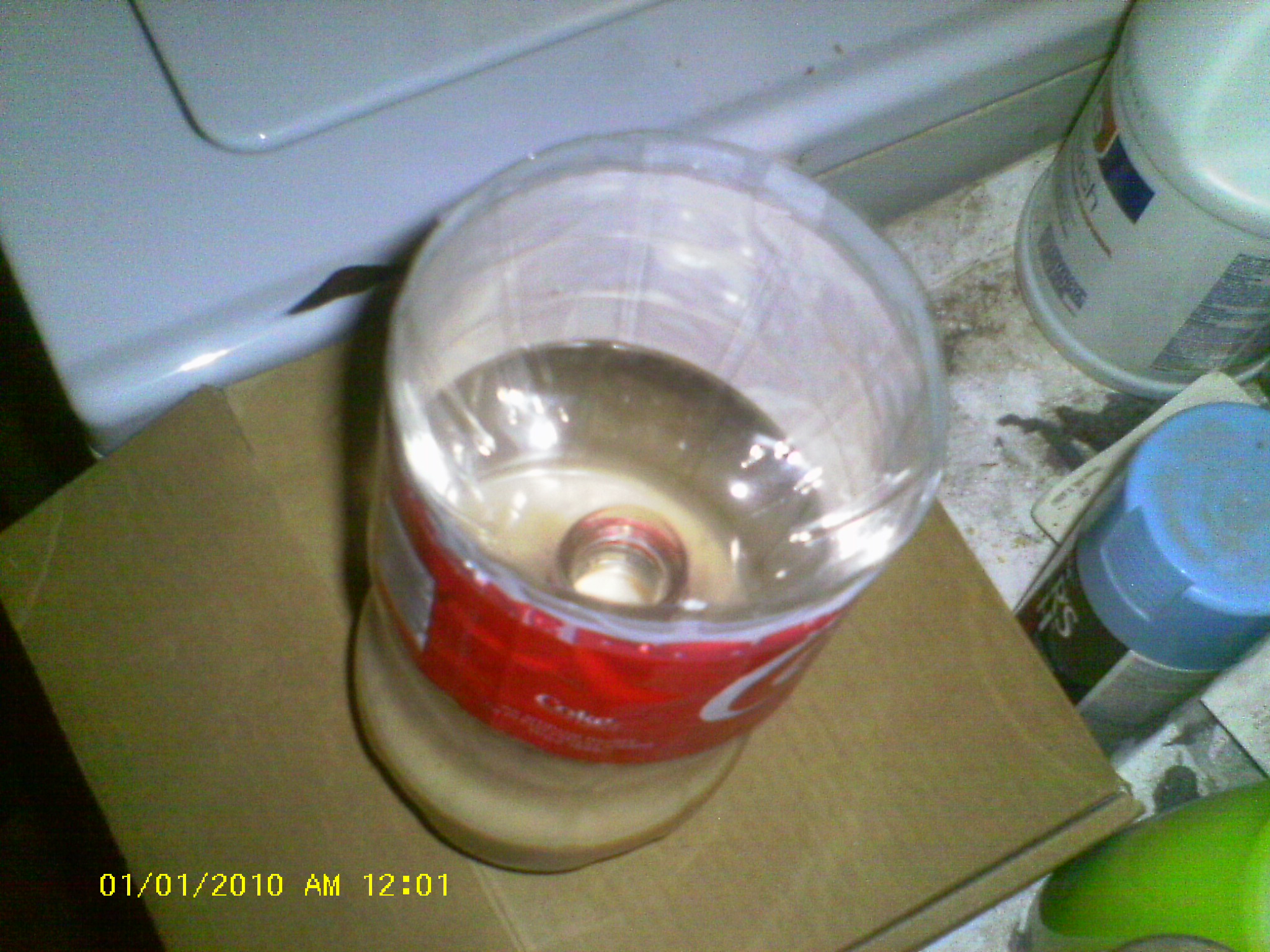
Turn the top upside-down into the bottom. Tape it in place.

Inverted top

Inverted top taped in place

Pour something inside that is attractive to flies. Coffee, milk, tuna water you just drained from the can, beer or even just water work. At least they need something to fall into and drown.

Tantalizing Fly Bait

Tantalizing Fly Bait

Leave this on the counter to attract any flies the kids let in. Since it’s cheap (basically already trash) there’s no problem tossing it into the trash when someone drops by for a visit and since it’s easy you can make another any time the kids let another fly in.

Posted by: briellethefirst | February 16, 2013

Simple Gazpacho


IMAG0155

Fun serving suggestion

A cold tomato soup. This is NOT supposed to be spicy. If you want spicy, just open a bottle of salsa and eat it with a spoon. Everybody makes it a bit differently, but this is how I learned as a kid. It’s one of the few recipes I liked in Home-Ec.

Of course you have a garden, even if it’s a few pots of herbs on the balcony, porch or windowsill. Most of these ingredients may be growing in it, so shopping time is minimal. Home grown is always best, but gardens happen at their own pace, so get what you must form the store and continue.

You’ll need: a cucumber, a couple large tomatoes, a couple ribs of celery, a bell pepper, a few cloves of garlic, an onion, basil and a bottle of tomato juice. Lemon juice perks it up, too.

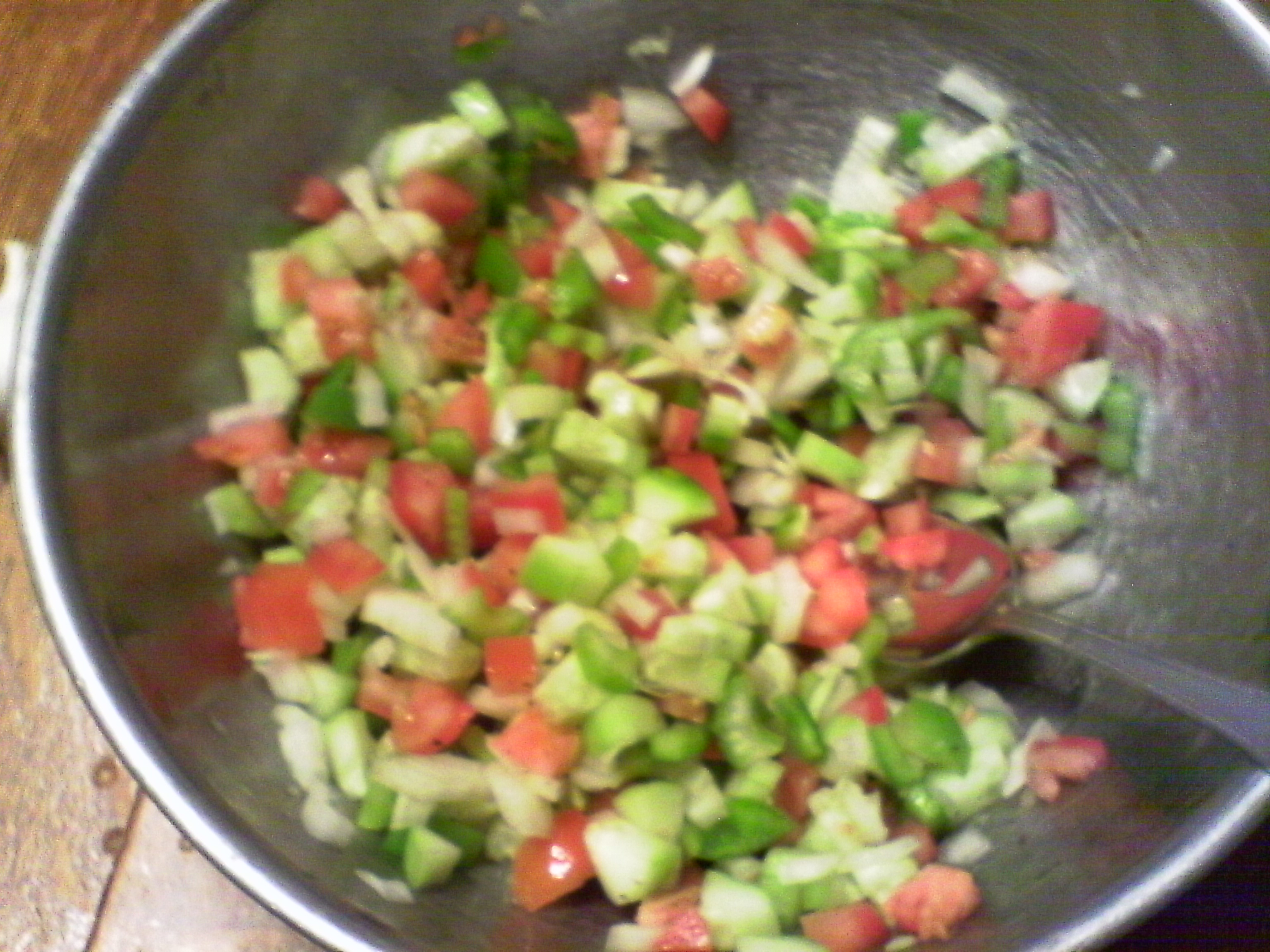
You all know what chopped veggies look like, so I’ll skip the individual pics.
IMAG0147

Chop and toss veggies

Cut up 1 onion (I prefer yellow, but white or red will do if that’s what you have or like). Also cut up a rib or 2 of celery, a bell pepper, a couple of tomatoes, a cucumber and garlic. throw them all into a bowl as you finish each and toss.

Sprinkle on some basil, oregano (fresh or dried), salt and pepper. Cilantro is optional but I add it when it’s growing in the garden. Add lemon or lime juice to taste.
IMAG0150

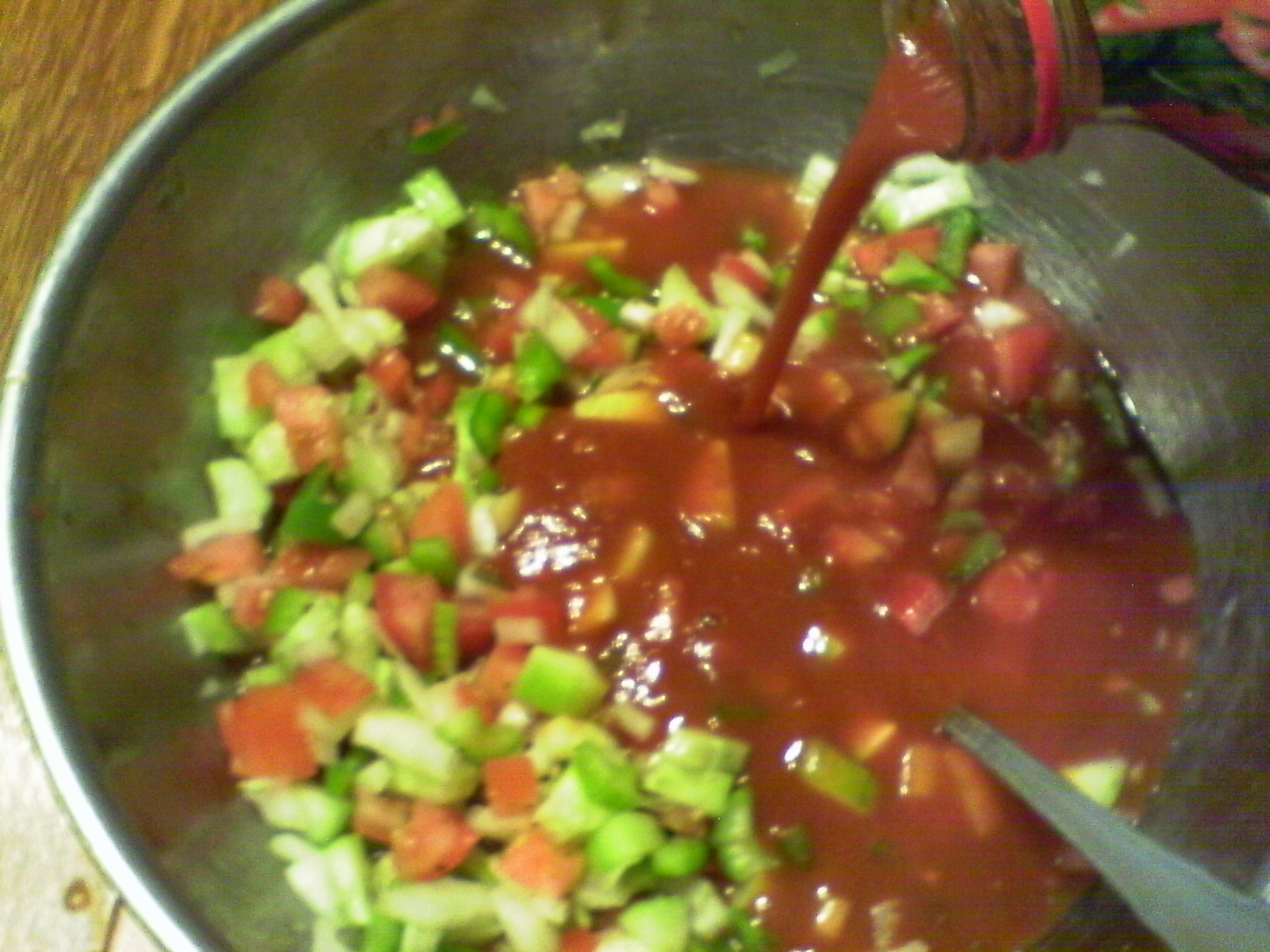
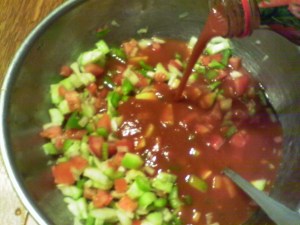
Add tomato juice

Next add a bottle of tomato juice. We used V-8 when I was a kid but there are many to choose from. *insert obligatory palm-to-head visual and “I could’a had a…”*
IMAG0152

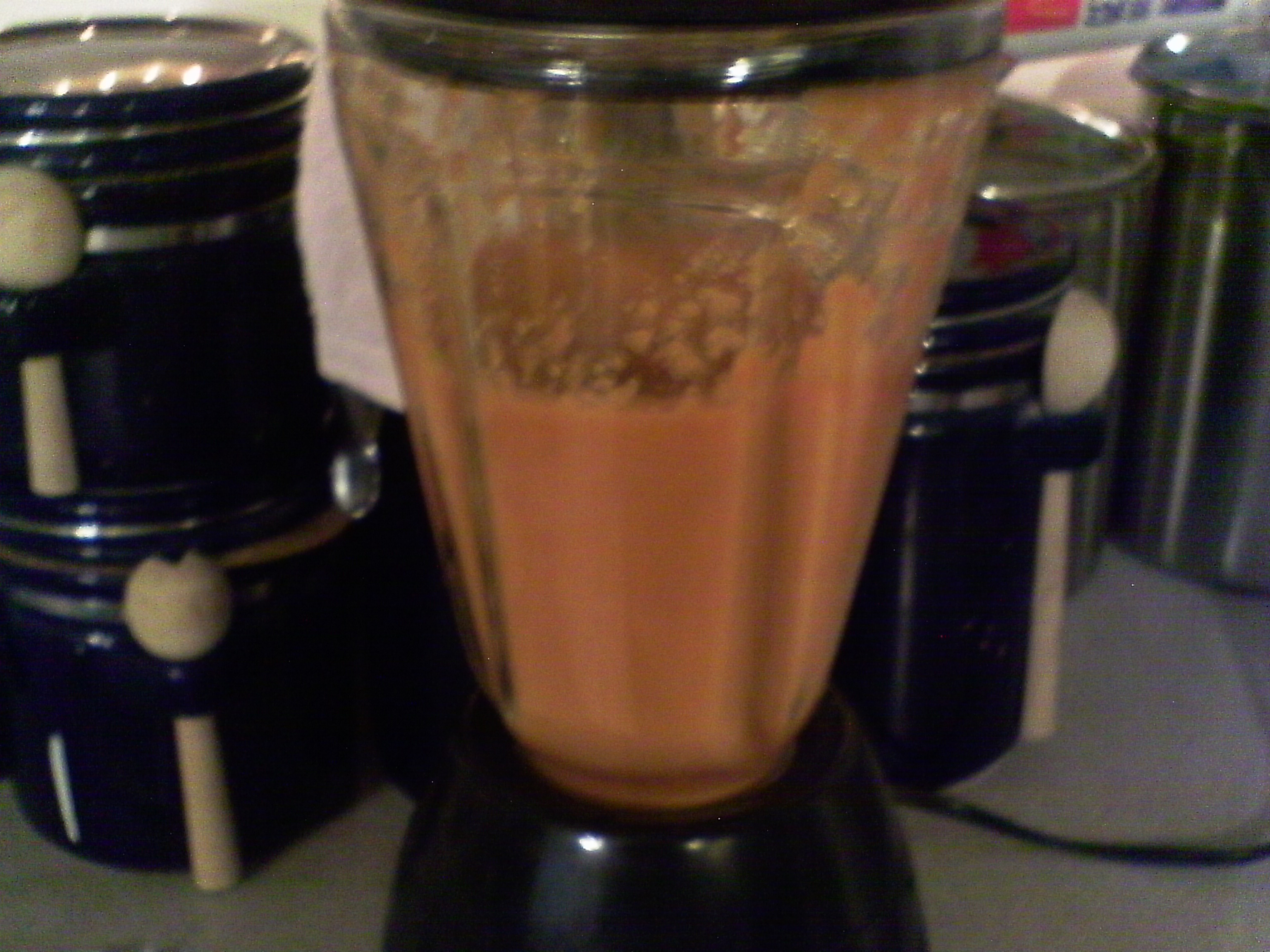
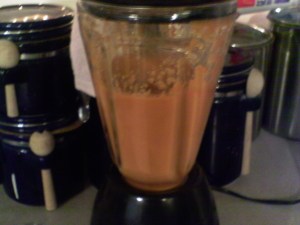
Whizz some of the soup

Mix it all well-in, then take about 1/3 and whizz it up in a blender. This thickens the soup-base. When it’s well blended pour it back into the bowl and stir well.
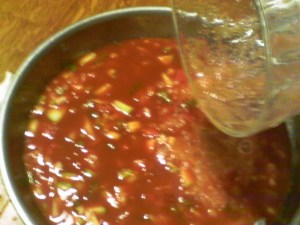
IMAG0154

Add whizzed soup back into main

Pour into a nice serving bowl to serve at the table. A  pretty ladle is nice to have for this. Individual servings can be in rustic bowls, mugs or pretty stemware.

Garnish with croutons, parsley, cilantro, finely cut onion slivers, chopped green onion, grated cheese, chopped peppers, celery or cucumber. Since borage flowers taste like cucumber they’d be a really pretty garnish, too, if you happen to have them blooming in your garden.

You can grow most of the ingredients yourself it you’re so inclined. This is a great recipe to introduce kids to chopping safely as well as the joys of eating directly from the garden. It’s also wonderfully cool on a hot summer’s day and no need to heat the house with cooking.

It’s nice at brunch, lunch or dinner and if you’re so inclined I guess you could turn it into a cocktail after dinner with some vodka or tequila.
Posted by: briellethefirst | March 16, 2012

Lemon, Basic Cough Syrup


Lemon. Citrus limon. Most well-known as lemonade and something we drip on seafood. YUM! If you are lucky enough to live in the right climate you can grow it in your yard. There’s also a song about it…”Lemon tree, very pretty…” but you don’t want THAT stuck in your head today. You know what it looks like…usually smaller than oranges, oval and yellow. I grew up in Arizona where they can sometimes grow as large as grapefruit, so when I moved to Florida and saw what passed for lemons there…pft! Really!? Sorry Florida, I know you probably grow the good stuff, too, but only offering in the grocery stores the things that resemble yellow Key Limes…really! OK, rant over.

I’ll include this in my Herb of the Week…because I can. My roommate had a bad cough last week so I made this for her. I got the recipe from my kid’s pediatricians. Yes, it has alcohol in it but the heating drives off some of the alcohol and taking it by the spoonful is not like doing shots. Also, this can be taken as needed, unlike many over-the-counter cough syrups that have all kinds of chemicals in them that you really don’t want to take any more often than you have to…and they never last to the next dose! The honey, lemon and whiskey/rum/whatever all have their medicinal functions. Honey is antiseptic, anti-fungal and soothing. The lemon is antiseptic and astringent. The alcohol is antiseptic. They each have more properties but right now, off-the-cuff I’m not pulling them from memory readily. I’ll add more later at the end when I think of it.

I should probably add that I am just a mom (occasionally opinionated), have no official medical training and this is not to be taken as medical advice in any way. It’s just something that’s worked for me so I’m letting you know why I tried it and how I made it.

Making this is easy. 1st you wash a 2 or 3 lemons under the tap. If you like using lemon flavour in things zest them before you juice them, using either a zester or a fine grater like this:

Zester and graters in drawer

Zester and graters in drawer

Dry the zest in a small bowl or plate before storing in a small jar like this:

Jar of dried lemon zest

Jar of dried lemon zest

Now cut the lemons in half and juice them. I have a juicer that catches the juice in a jar underneath, while most of the seeds stay on top. You’ll want to use a tea strainer when pouring the juice into the measuring cup, though, to get the pulp (and any tiny seeds) out. I got 2/3 cup juice from 3 lemons. This will vary depending on the size of your lemons and how many you use. Since the lemons are the really variable part of this and you will use equal parts of lemon, honey and booze, I’m starting the measuring process with the lemons. If you get 2/3 c each then you will end up with about a pint of syrup.

Juicer and strainer in the washer

Juicer and strainer in the washer

Once the juice is in the glass measuring cup add the honey and then the whiskey/rum/brandy (whatever you happen to have on hand). Pour into a small saucepan, using a spoon to get it all out of the measuring cup. Now warm over medium heat and stir it until it’s all combined. It won’t take long and will be a very thin, liquid syrup. Pour into a clean, dry pint jar and keep in the fridge for up to a week or 2. Taking cold syrup feels good, too.

Jar of syrup

Jar of syrup

This is good for all ages as long as they’re old enough to consume honey (children under 1 or 2…consult your doctor) and any anyone who isn’t allergic or sensitive to the other ingredients. I knew a man who couldn’t drink or use alcohol in any way…if he did it would raise nasty blisters like burns! You probably already know if you can use these 3 ingredients, so if you make and use it, do so in good (or improving) health.

Posted by: briellethefirst | March 10, 2012

Horehound


Sometimes called White Horehound, Marrubium vulgare is in the Mint family but is best known as the main ingredient in ages-old-fashioned cough remedy. It’s also supposed to keep spiders, flies and scorpions out of the house and garden. You can use the leaves and stems to flavour ale as you would use hops, although it can be an acquired taste. Horehound can also be used in dried arrangements and potpourri. As a cold remedy it is used in teas, syrups and is best remembered as candies or lozenges given to children as recently as my Mother’s childhood (and resurrected in my youth). Used as a treatment for gas and indigestion, it’s best known as a cough and sore throat remedy. Most of my older relatives have mentioned it at one time or another. Of course, you wouldn’t want to give them to very small children or anyone who would be in danger of choking on a lozenge.

Horehound is a perennial that grows between 1 and 2 feet tall and may be used as a border plant, but has a rangy habit that some gardeners find rude and invasive. Indigenous to waste places of Britain and Europe, it now can be found wherever people have planted it. The scent is strong and somewhat like Thyme. The wrinkly, wooly leaves can be up to an inch long. After about 2 years it will put out white flowers. Black Horehound produces purple flowers and has similar properties but stronger flavour that may be less appealing. It likes full sun and well-drained soil but will survive a surprising amount of abuse and neglect unless the neighbourhood cats decide they like ti as a catnip substitute, which is why this post will have to wait for a picture from my garden.

To make the candy you’ll need 1/4 cup (or 1/2 cup fresh) Horehound, 2 cups boiling water, 2 1/2 cups sugar, peppermint flavouring, food colour, 1 cup superfine sugar, a saucepan and a jelly roll pan…and a strainer. If you use brown sugar the colour of the finished candy will be darker.

Take the horehound leaves and steep them in the boiling water for about 15 to 45 minutes. Don’t boil them pour the boiling water over them and allow them to steep, as if you were making a tea. Strain the plant parts out, keeping the liquid to add into a heavy saucepan. Butter a jelly roll pan for later. What’s a jelly roll pan? It’s like a cookie sheet, but with low sides. So, on with the recipe.

Add the sugar and light corn syrup to the horehound tea and heat over medium heat, stirring constantly until it comes to the hard crack stage (300-310 degrees Fahrenheit). If you don’t have a candy thermometer you can take a cup of cold water and drop a little bit of the syrup in. At this stage it will form hard threads that will break when bent.

Cooking candy

Candy cooking

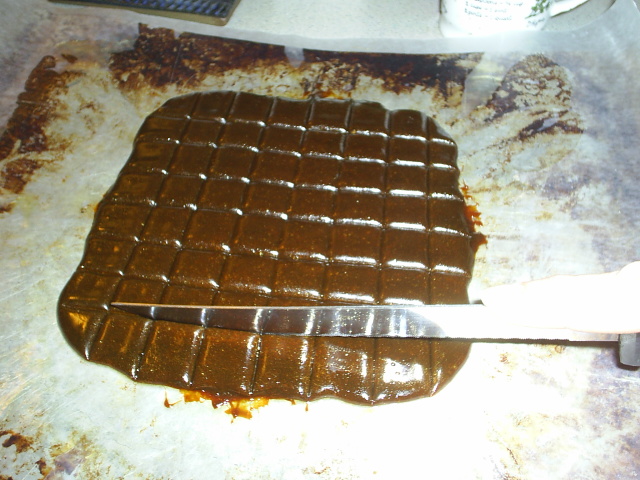
BE VERY CAREFUL, sugar is very sticky and can cause severe burns at this point! Add a few drops (1/2 Tsp or maybe a cap-full) of peppermint flavouring and maybe some colour then pour onto the buttered jelly roll pan. It will be thick and stiffen fairly quickly, so have a large knife ready to score the sheet of molten sugar but be careful, it cools fast but you still have to take care not to burn yourself while working with it.

candy cut into lozenges as it cools

candy cut into lozenges as it cools

Use a large knife to score into lozenge-sized pieces, usually square or diamond-shaped. The pieces will take on pillow shapes as you press the knife into the sheet of cooling, molten sugar. It works better if you press straight down instead of trying to slice it. The knife won’t usually stick to the sugar (surprise!), but if it does you can give it a very light swipe with butter or oil. The inside stays hot longer, so you may have to keep after it to keep it from flowing back together. When set and cool enough to handle break the lozenges apart and give each a coating of superfine sugar by dredging them in about a bowl with about a cup of superfine sugar in it. Store in a tin with double layers of waxed paper separating the layers of candy. This recipe also makes pleasant candy by substituting any herb or combination of herbs for the horehound.

Posted by: briellethefirst | February 24, 2012

Oh, Dear!


About a week ago a couple of friends came by to pick up some sewing I hadn’t quite finished yet. In my defense, I needed a head to make the hat on, so they supplied one while they waited. A few other things happened while they waited. More props were picked out and polished for the film, La Marseillaise was sung (a lot, because it’s stirring!) and Chess was discussed. This led to the old hand-written version of my book being pulled down off a shelf. The writer/producer was delighted, wanted to use it as a prop in the next portion of the filming and asked if I could bind it in leather by then? I am amused and delighted that, without skipping a beat, she assumed that I would be able to do this thing. What a marvelous complement! Now I’ll have to pull out the leather and those books on bookbinding and see what I can come up with. This should be fun. I’ll keep you posted.

Unbound original

Unbound original

Posted by: briellethefirst | January 6, 2012

Wish Upon A Star…And Other Ways


IMG_20190102_061302On New Years Eve 2012 I saw a bright, green fireball meteor streak across the sky. Major wish score! Remember wishing on stars when you were a kid? Do you remember the rhyme?: “Star light, star bright, first star I see tonight, I wish I may, I wish I might, have the wish I wish tonight.” Then you make your wish. This is for the 1st star you see, but if you see a shooting star you get another chance for a wish.
There are other common ways of wishing. Wishing wells and fountains are popular for exchanging coins for wishes, dating back to prehistory beliefs when people would toss all sorts of things into wells and waterways for (presumably) the same reason. Sometimes they also tied ribbons or rags to branches (usually near special wells or springs) or left little offerings in special places in exchange for a wish to be granted.

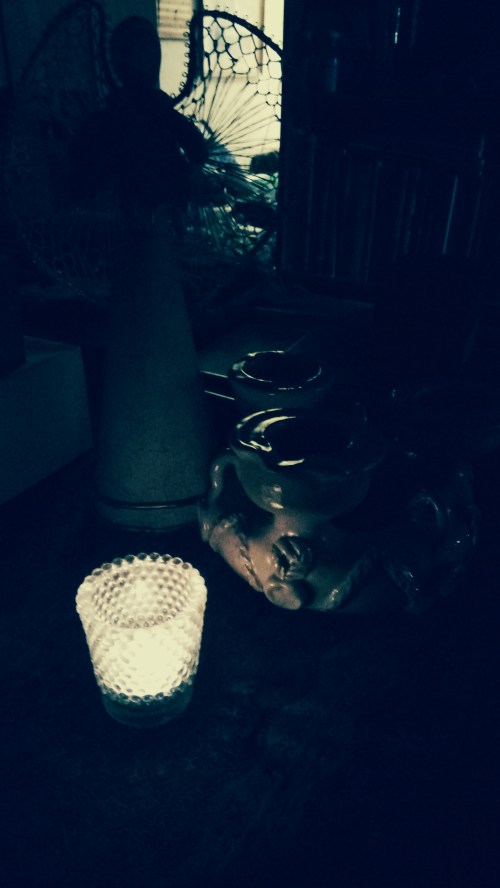
IMG_20200302_203147You can always light a candle. There are lots of them in most Catholic churches, but you don’t need to be Catholic. This is where the phrase “light a penny candle came from.  Just drop a coin in the offering box (there’s the coin part of wishing again, but please leave more than a penny), light the candle and make a wish. Usually this is used for something serious, like keeping someone safe or getting well from a serious illness or injury.

IMG_20200302_202622Wishbones are especially popular around Thanksgiving, but can be used anytime a roast chicken or turkey makes one available. Clean off any meat, let it dry, and after the meal one person takes hold of one side and the other takes the other side, they each make a wish, count to 3 and pull. The one holding the biggest piece gets their wish granted. Before you pull you should agree on the method of holding, though, so you each either hold it with thumbs against the pointy-part facing upwards or you each hold the tips only. If one holds one way and one a different way only one will have an advantage.

Blowing things to carry wishes is popular. When you find a full-fluff dandelion you can carefully pluck it, make a wish and blow. Your wish will be carried on the wind, one hopes to whatever Deity will grant it. You can do the same with fallen eyelashes. When you find one has fallen on your cheek, gingerly take it on your finger, make a wish and blow. Of course we all get the chance to wish once a year as we smile while friends and family sing the usual song, then make a wish and blow out the candles. Shh…if you tell it won’t come true!

Some people talk to bees, birds and ladybugs, If a ladybug lands on you say “Ladybug, ladybug fly away home, your house is on fire and your children are home!”. If she flies away you can make a wish. Many old-time civilizations believed birds were messengers of the Gods. Beekeepers and many gardeners in parts of the British Isles will talk to bees when they come upon them in the garden (or elsewhere?), at least to give them news of the most recent family events such as births, Christenings, weddings, deaths…so asking birds and bees to carry wishes to the Powers That Be only makes sense.

There are other wishing customs from all over the world, but these are the most common from my childhood. The nice thing about all this is that it reminds us to keep up our belief in the possible. Yes, the possible, as in all things are…, so if you can imagine it there must be some way for it to be so. Keep believing, keep wishing, keep trying and eventually we can make the world better.

Posted by: briellethefirst | August 28, 2011

What Was It Like?


Well, a lot of people think it was like this:

Pray, Attend Their Royal Majesties!
Pray, Attend Their Royal Majesties! 

With maybe a little bit of this:

For the Queen's pleasure

For the Queen's pleasure

More of this...
More of this…
And lots of this
And lots of this
For the Queen’s pleasure… 

And many would REALLY LOVE to see this:

BUNNYFUR! BUNNYFUR! BUNNYFUR!

But this is more like what it was…:

CLANG! OOF! BAM! POW! ... OUCH!
CLANG! OOF! BAM! POW! … OUCH!  

With a lot of this in between:

You guys go there while we run over...hell, who's up for a dip in the creek & some beer?
You guys go there while we run over…hell, who’s up for a dip in the creek & some beer?

And we lived to tell the tale…many of them…if you dare ask. Hint: A beer or three help to jog the memory.

Posted by: briellethefirst | August 28, 2011

Parsley


Ah, Petroselinum crispum. All too familiar garnish in both dining room and garden. It’s so easy to think of this as that boring old green thing we have on hand just out of habit, but it’s so much more. Let’s start with the joys of Parsley in the garden. It grows about 1 1/2 to 2 feet tall and you generally have a couple of varieties to choose from, plain flat Italian and the more familiar curly variety as well as a variety grown for its root. Depending on where you live it’ll be either an annual or biennial. Some places let it grow long enough to make flowers the 1st year and some places it goes dormant for the winter and sends up flowers the next season. It is related to carrots, fennel, coriander and dill so when it flowers it’ll look like them with yellow flowers in an umbrella-shaped spray. Mine has been re-seeding itself for years now, taking over more or less of the little garden in front of the bedroom window.

You can buy transplants, and if you look closely you’ll probably see that what at first looks like a single plant is actually a few seeds that germinated together. If you’re careful you should be able to separate them before you transplant them if the potting soil is dry enough but not too dry. They seem to get off to a slow start but you can spread them out to get more mileage out of them. Starting them out from seed can take a while, so long in fact that there is an old legend saying that the seeds need to travel to Hell and back seven times before sprouting. It’s really nice as a border for an herb or flower garden and as an added bonus it’s a good companion plant and hosts beneficial insects that prey on things like tomato horn worm. If you let it re-seed itself it isn’t hard to pull it out of the places you don’t want it and transplant to the places you do. If you don’t need transplants you can use it in the kitchen or feed it to the chickens or hamsters.

In the kitchen parsley is a standard addition to soups, stews, roasts and such, so common it’s easy to overlook and forget. Time to get re-acquainted. It’s slightly bitter and tastes fresh and green. The flat Italian variety is less bitter and many think more flavorful. Get a plant or two for the windowsill or garden and nibble a bit, then add some (un-nibbled) bits to your cooking. By the way, it’s supposed to freshen your breath and be packed with nutrients. You can buy dried parsley but it’s much better fresh-cut, even if you have to get it from the produce department. Try growing it, you’ll be much happier.

Parsley has been cultivated for over 2,000 years and in that time has not only been used in kitchens but also to adorn victorious athletes and to decorate the tombs of the deceased. It plays an important part in the Hebrew Passover celebration.

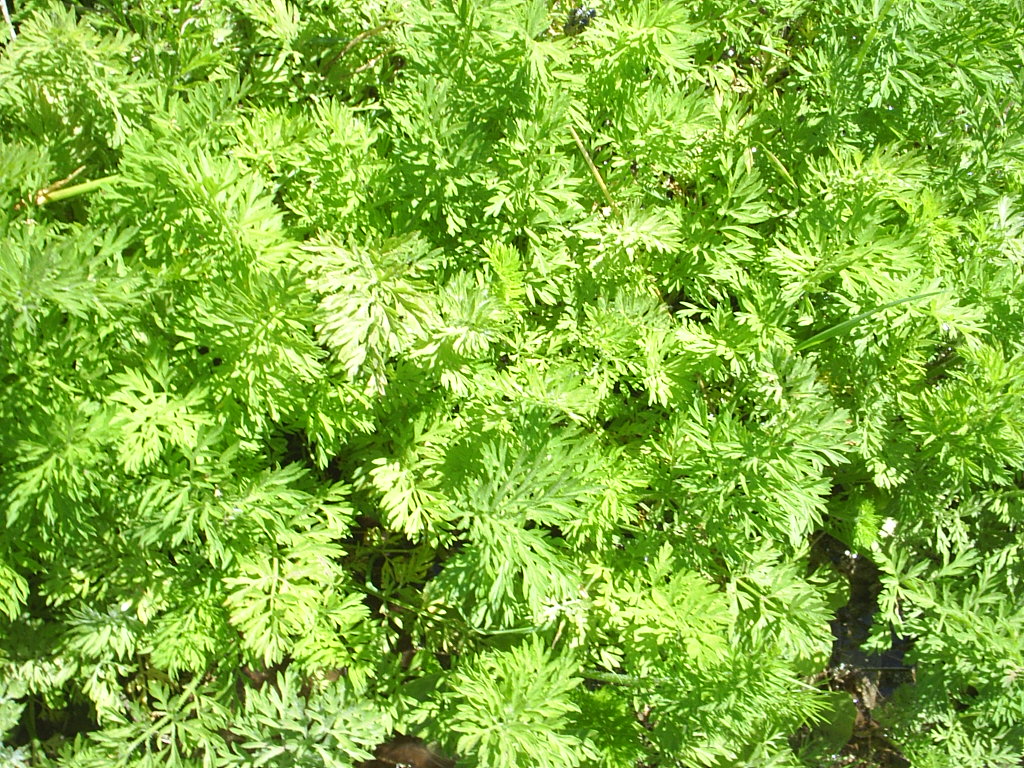
Parsley gone wild

Parsley gone wild

It was believed that when the Greek hero Archemorus was eaten by serpents parsley sprang from his blood where it fell to the ground. Until my next generation of parsley makes its final trip back from Hades this picture will have to do. It gets a bit feathery right before it flowers.

Posted by: briellethefirst | August 20, 2011

Paprika


Pepper plants

Pepper plants

Explorers to the New World took all sorts of cool things back to Europe. Capsicum annum, paprika, was among them. I’m glad. It’s fun to grow and use and I use a lot of it in my cooking. It’s an occasional resident in my garden and usually surprises people. They usually ask if it’s jalapeño or some other hot pepper. They do look similar, but my skinny red pepper is sweet. I got my seeds from Nichol’s Garden Nursery catalog. They have a website: https://www.nicholsgardennursery.com/store/

Grow paprika like any pepper. They seem to like a little shade where summers are hot, like Arizona and Florida, and they seemed to love the humidity in Florida. They’re susceptible to the same bugs and diseases as other peppers as well as their relatives in the nightshade family: tomatoes, potatoes, eggplant and tobacco. I don’t let people smoke around my garden so they can’t spread any diseases from the tobacco. The bushes are pretty, asymmetrical, delicate (they break easily) and don’t get terribly big and they make nice potted plants. I had 4 in a 12 inch pot one season.

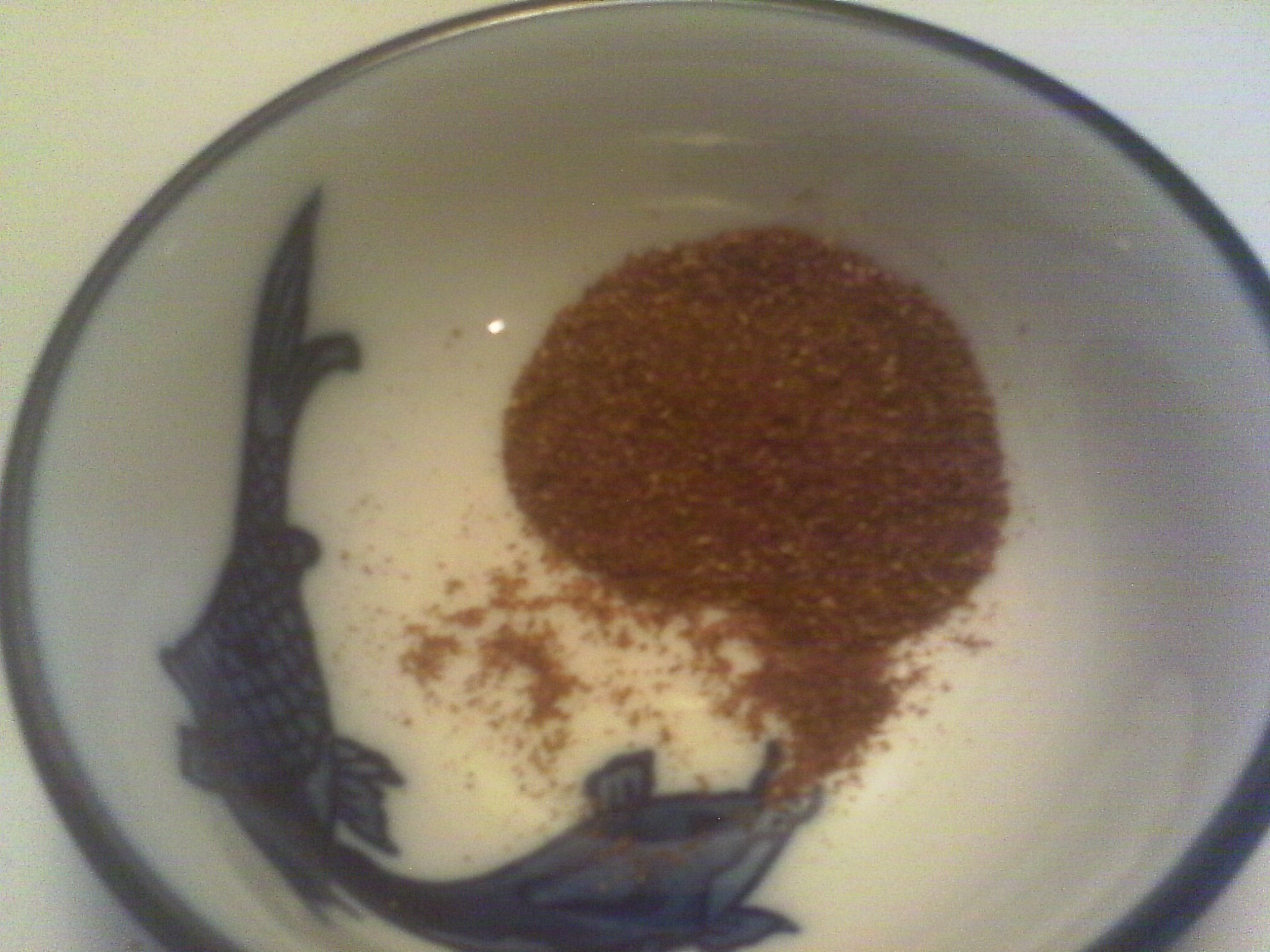
Ground paprika

Ground paprika

I’ve used it fresh and dried. When you use it fresh it doesn’t matter whether it’s red or green but red is flashier. Just chop, slice or ring it and throw it into whatever you’re simmering or sautéing. It is a great help to roasts, fish, fowl, eggs, pasta, veggies, herbed butters and herb blends (when it’s dry).

To preserve it I usually dry it but freezing works, too. Just chop it, freeze it in measured servings, bag it and use as needed. If it sticks together just bang it on the counter. Drying is just like other herbs but takes a little longer (fruits are juicier than leaves). Cut them into strips or dice them and when they’re dry store in a glass jar. If you want to be more decorative you can string them into a ristra and just hang them until they’re dry. Make sure they’re clean, dry and unbruised and have good air circulation so they don’t get fuzzy. You can grind them in a mortar and pestle or an old coffee mill as you need the powder. You won’t want to use the coffee mill for coffee again, though. If you decide to start going the mortar and pestle route you may get addicted and start a collection, different sizes, styles and materials for different uses. You can even find them in big-box-stores. Oops, yet another shopping spree.

Pepper flowers

Pepper flowers

If you don’t have room or a sunny place to grow your own (since that would be just about the only reason not to) you can buy it. The most familiar may be Hungarian (origin of goulash and chicken paprikash) but it is also grown in Spain, California and the Netherlands. It’s high in vitamin C and antioxidants. Apparently it can also be added to henna for a different red when colouring hair.

« Newer Posts - Older Posts »

Categories